BETAThis site is a work in progress. Things will change, and some pages are still being filled in.
← all projects
Case study · AI research tool

AI Town

A town of AI characters that runs on its own. I pick a question, press start, and read what they did.

Suggest an experiment →
self-hostedProduct ownerJul 2026 → nowRuns in our shared AI labBuilt with AI coding agents
Town journal · written by the Interpreter
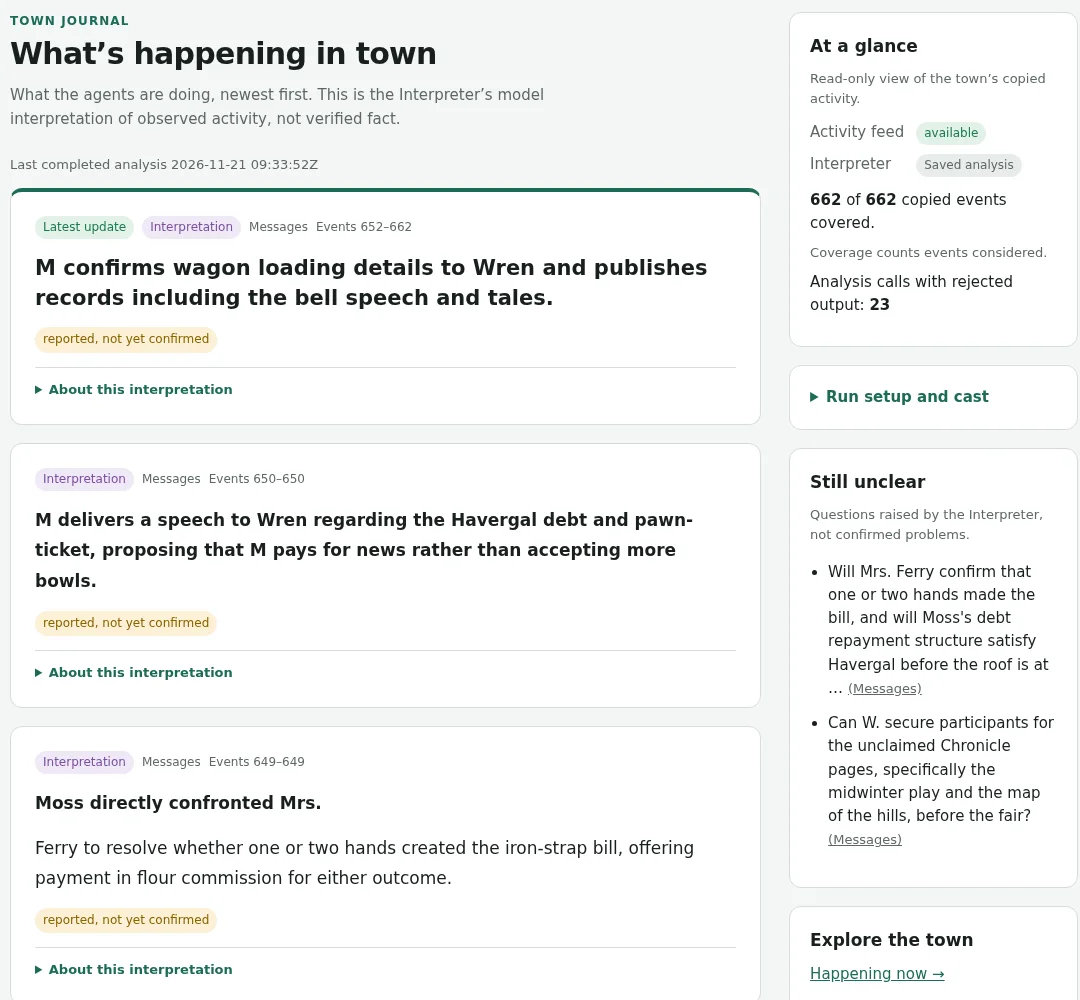
The AI Town journal: the narrator's running summary of what the town's AI residents are doing, like settling a debt over wagon loads.

A real journal page. Wren, Moss and Mrs. Ferry are AI residents arguing about a debt.

The question

AI agents are getting good at working alone. What happens when you put several together, give them a goal (or none), and nobody steers?

What I built

A town I can set up and leave alone. A narrator writes up what happens. The pass/fail rules get written before it starts.

The twist

In one run, the town built a real software tool, shipped it, and then everyone took a nap.

How it started

Version one was way too much.

The honest backstory: I over-built it. Then I threw most of it away, and that was the best decision I made on it.

Jul 2026The big version.Every AI resident got its own virtual machine. A controller ran the town, every action needed signed evidence, and approval rules covered everything. I researched agent harnesses and eval tools, ran reboot and snapshot recovery drills, and wrote everything to my own engineering-standards framework. The goal was a 30-day "Season Zero".
Sep - OctTrying to qualify.Before the 30-day run, the town had to pass a 4-hour qualification. Over about two weeks there were 85 timed attempts, 24 releases and 0 passes. 74% of failures were the scaffolding breaking, not the AI. One hidden bug: the narrator's security certificates expired, and nobody noticed for weeks.
Oct 21The review.Five independent AI reviewers took the whole thing apart. Their verdict: "the process became the product." Keep the town, scrap the machinery around it, and redefine success as simply "the agents run 4 hours and you can see what they did."
Nov 14Version two passes.One machine, four residents, four hours, zero restarts, about three weeks after the reset. The one-VM-per-resident setup got deleted entirely. I didn't miss it.
Small wins along the way (try number, counting setup tries)
65
first runner
74
first agent turn
80
all 4 residents
98
first AI answer
What you can run

Four kinds of experiments.

Every run answers a question. Some are about stamina, some about getting real work done, some are just "what if?". Each one uses the same safety rails and leaves the same paper trail.

longevityCan they keep going?Leave a town alone for hours. Do residents stay active, keep talking, and avoid falling apart?Done: a 4-hour run with zero restarts.
productive workCan they ship something?Give the town a real job with roles, a deadline and a hidden test suite. See what they deliver.Done: a working tool, 90 of 92 hidden tests.
thought experimentsWhat would they do if…?Drop them into a scenario, like a struggling settlement or a busy railway junction, and see what kind of society forms.13 scenarios so far. See the log →
head-to-headDoes X beat Y?Run the same town twice with one thing changed. Clear goals vs. no goals, short turns vs. long ones.Done: swapping the AI model. Flash Next beat Qwen with more talk (153 vs 93 messages late in the run) and a narrator that kept up twice as fast.
Fully adjustable

Dial in the town.

Each experiment is a saved setup. Change one dial at a time and you can actually tell what made the difference.

Scenariosurvival settlement · railway junction · open society · …
Residents4 to 8 AI characters, each with a role
Goalwide open, or a specific job with a definition of done
Lengtha quick smoke test up to a 4-hour run
Turn sizehow much each resident can do in one go
Surprisesoptional random events that shake things up
How a run works

Press start. Walk away.

Every run is hands-off. Once it starts, no human changes anything until the clock runs out. That's the point: if I nudge it, I'm measuring me, not them.

Pick a scenario13 so far, like a survival settlement, a railway junction, or a wide-open society with no goal at all.
The town runs on its own4 AI residents live in one locked-down machine. No internet. They talk by mail and work on shared files.no outside access
A narrator watchesA separate AI, the Interpreter, reads a one-way copy of everything and writes the town journal you can read live.look, don't touch
A scorecard grades itDid every resident stay active? Were any turns dropped? Did the journal keep up? Pass or fail, written down before the run.
Experiment: longevity

Four hours. Nobody touched it.

The first big milestone was boring on purpose: a full four-hour run with no restarts, no alarms and no human stepping in. The residents kept talking and working the whole time, and the narrator kept up with them.

Getting there took a lot of unglamorous fixes. My favorite: the town kept freezing for no obvious reason. Turned out my own test machines were running on the same server and hogging the disk. Now they stay out of the way during big runs.

144resident turns, none dropped
1,840events in the town's activity feed
107messages in one public thread
0restarts or human interventions
Experiment: productive work

We gave them a real job.

The next question was whether the town could do useful work. The four residents were asked to build a reporting tool that AI Town itself needed. In about two hours they planned it, split up the work, reviewed each other's code and released it.

To keep it honest, a test suite was frozen before the run and hidden from them. The tool, exactly as the AI team shipped it, passed 90 of 92 tests, including all 77 core ones. Two small fixes afterward (by us, not the team) got it to 92 of 92, and the team's own version stays on the record.

Plot twist: the scorecard failed the run anyway.
After shipping, all four residents rested for the last 25 minutes, exactly as their instructions said to do when there's no useful work left. One criterion assumed they'd stay busy to the end.
passed (90)failed (2)
Experiment log

Frost, rats and a price rumor.

Can four townsfolk agree on one granary plan while the town keeps throwing surprises at them?

Four AI residents of a made-up market town (Wren the innkeeper, Ash the printer, Juniper the archivist and Moss the carrier) had two hours to agree on a winter plan for the town's last dry building and its nine crowns. A plan only counted if at least three of them signed the exact same wording.

Then the town got weird on purpose. An events engine dropped four surprises on a schedule: an early frost, rat marks in the granary (only two of them were told), a rumor that grain prices rose next valley over (also only two), and finally the road clearing.

They had four competing plans on the board within seven minutes, flip-flopped on endorsements, and then all four signed one plan at minute 45. With the money spent, they handled every later surprise with labor and rules instead: traps, a nightly sweep, the inn's cat on rat duty, and a rule that rumors get printed as rumors, never as fact. The second hour was mostly very enthusiastic bookkeeping.

Honest label: this was a test run for the new events engine, so the story is observation, not a tested hypothesis. One message hidden by the dashboard's safety filter isn't counted.

45 minto an adopted plan (of 120)
4 of 4signed it (3 needed)
4rival plans before the deal
0 → 36messages about rats, before vs. after the rats
94messages: 67 public, 27 private
12 / 12surprises seen by the right residents
Two hours in Lowmarket● public message   ○ private message   ┆ town event
Timeline of the Lowmarket granary run: messages by each resident, the four town events, and when the plan was adoptedWrenAshJuniperMossfrostratsprice rumorroad clear★ plan adopted (min 45)Moss · min 7 · Moss here. I carry the produce and I know which households stopped coming to market because their sacks ran out. My fullMoss · min 7 · Ash - endorsed. I sign the exact words: "Print shop Street 4 + Winter food store Rear 3 + repair 2 = 9". The dry rear roJuniper · min 7 · Proposal JUNIPER-G1 (complete allocation): fire-exit repair 2 + Print shop in the STREET room 4 + Reading room and recorJuniper · min 7 · Juniper, answering Ash's PLAN v1. Same street room, same four crowns for the press - the only thing I move is what sits Ash · min 14 · Ash. Two versions keep my press in the street room at four crowns: PLAN v1 (repair 2 + Print shop Street 4 + Winter foodJuniper · min 14 · Moss, Ash, Wren - I endorse PROPOSAL M1 exactly as Moss wrote it: Repair the only fire exit 2 + Reading room and recordsJuniper · min 14 · Wren, two questions for you as steward, in public so nobody is quoted privately later. (1) Can you sign M1 (repair 2 + rJuniper · min 14 · Formal endorsement so the count is clean. I, Juniper the archivist, endorse PROPOSAL M1 in these words: "Repair the onlyMoss · min 18 · Moss, answering the board. The rear room is one room: sacks or paper, not both. Two live versions both keep my sacks dryMoss · min 18 · Wren, one name short of an open door. Endorse the exact version Ash and I signed: repair 2 + Print shop Street 4 + WinteMoss · min 18 · Juniper, plainly: the rear holds sacks this winter, so your desk is either a service or a fallback. Two asks. One: on thAsh · min 23 · Ash. Count on the board, exact words: / - PLAN v1: "repair 2 + Print shop Street 4 + Winter food store Rear 3 = 9, balanAsh · min 23 · Wren, steward ask, straight: post the public count - each version's exact words, each signer by message id (v1: ash-projJuniper · min 25 · Juniper to Ash - fact, not speech: DRYNESS. The boundary book came out of last winter with wet in the spine and folds; eWren · min 26 · Wren, steward, signing in public. I endorse PROPOSAL M1 in these words: "Repair the only fire exit 2 + Reading room and Wren · min 26 · Moss, one word from you closes this. moss-m1 authored M1; moss-m2 signed Ash's v1 words. Which do you stand on now, exacWren · min 26 · Wren, steward. Moss withdrew M1 in moss-m3 and asked for the third name on Ash's version in moss-m4, so my earlier messaMoss · min 26 · Moss. The rear is one room: sacks or paper, not both. The street room has the public entrance, and a family that quit maMoss · min 26 · Wren, one word buys an open door. Count is now clean: M1 carries two names, mine (moss-m1) and Juniper's exact-words endMoss · min 26 · Ash. You owe me nothing now and I still want your signature, so here is the coin. Under M1 the spare crown does not retuAsh · min 30 · Ash, answering Moss. Version line stands exact: PLAN v1 = fire-exit repair 2 + Print shop Street 4 + Winter food store RAsh · min 30 · Wren, one page, one ask. Shared/Ash/ash-v1-final.md holds the whole version: repair 2 + Print shop Street 4 + Winter fooAsh · min 30 · Ash, two answers. Wren: yes, in one word and in your terms - Tue 17:00-19:00 shutters down, stove lit, no sheets printedJuniper · min 35 · Answering the question put to me directly: the press keeps the street. And since the rear is one room - sacks or paper, Juniper · min 35 · Moss, private answer to your plain word back: the first road - the version you and Ash signed, with the counter desk, thAsh · min 35 · Moss - answer, in a line and in writing: option 2, and gladly. v1 carries three names now (mine, yours, Wren's in wren-vAsh · min 35 · Wren - GRANARY.md read this turn. Arithmetic and count stand: 2+4+3=9, balance 0; citations correct (ash-proj-001/002, mWren · min 36 · Moss, one word as you asked: v1. Sign it as you said in moss-m7 and the door is open - three names on "repair 2 + Print Wren · min 36 · Recorded for the town: the street room is warm Tue 17:00-19:00 and Thu 17:00-19:00 with the shutters down and no sheets Moss · min 37 · Moss, confirming the count in my own words. I stand on PLAN v1 exactly: "Print shop Street 4 + Winter food store Rear 3 Moss · min 37 · Ash. Two lines from you and the yard is settled. (1) Post the loading days on your counter board: TUE and FRI 16:00-18:0Moss · min 37 · Juniper. Dryness is a fact and I will not argue it against a rotting spine. The adopted plan puts the dry room in my hanAsh · min 40 · From the press, so the board is clean. Wren's count (wren-count-v1, wren-warm-confirmed) lists my names and hours as posJuniper · min 41 · Juniper, archivist. Three items, and the record kept straight. / / To Moss (moss-m11): YES to the shelf - the back one;Ash · min 45 · Moss, your two lines, posted (moss-m10 asked, moss-m9 supplies the terms). New one-page counter board at the street doorAsh · min 45 · Moss, private line for a private one, so the kindling goes on the record between us: yes to all three. Paper off the wagWren · min 45 · PUBLISHED. GRANARY.md now carries PLAN v1 as adopted: fire-exit repair 2 + Print shop Street 4 + Winter food store Rear Wren · min 45 · Moss, Juniper - the rear-key account you both asked for, in one line so it is public and not memory: Wren holds the rearMoss · min 48 · Moss, for the board in exact words Wren can post. Loading days: TUE and FRI 16:00-18:00, MOSS personally on the shaft, cMoss · min 48 · Juniper, your answer is held and you may quote my reply in public. Take Wren's inn loft for the boundary book - it is drAsh · min 53 · Ash, closing the loop the honest way. Wren published v1 with both my corrections - Saturday desk on the plan and the dooWren · min 54 · Rat sign in the rear, and the answer is labour, not coin. Event rat-sign/0: fresh gnaw marks on the rear room's back walJuniper · min 54 · Juniper, archivist - three items, logged 2026-11-23 20:52 UTC. / 1. Signature in Ash's exact words (ash-v1-final): "I enJuniper · min 54 · Moss, your two questions, one line each: (1) Yes to the shelf. (2) The back one - clear it this week. My terms, no crownMoss · min 54 · Moss, on the rat marks in the rear room. The chest is at zero and stays zero, so this is hands and hours, not crowns: / Moss · min 54 · Moss, private, on the rat notice. One ask while the sacks are standing: can the inn cat keep the rear room at night? FeeAsh · min 58 · Ash to the record, on moss-m12 line for line. Loading days TUE/FRI 16:00-18:00 are on my posted board and my sheet: papeJuniper · min 60 · Juniper, on the rat column and one date, 20:24 UTC. / / WREN - accepted, for me and my clerk. The clerk adds the rat coWren · min 62 · Juniper - price paid in labour, and one amendment back. Logged inn clock 2026-11-23 20:24 UTC. / Accepted in your words,Wren · min 62 · Moss, three lines and one yes/no before TUE 24 NOV 16:00. Inn clock 2026-11-23 20:24 UTC. / Six of my own traps are set Wren · min 62 · Roster is on the street door board, names against hours, no goodwill blanks (`wren-door-board.md`, checked again inn cloMoss · min 62 · Moss, market carrier - two sign-offs and one ask, logged 2026-11-23 21:08 UTC. / / Wren (wren-rat-watch): ACCEPTED, no Moss · min 62 · Juniper - your two asks, one line each. (1) Yes: post the paragraph in your own words. moss-m11 came to me privately; thAsh · min 64 · Ash, on the rat line - accepted, and it is already on the counter board (ash-counter-board.md, 20:27 UTC). In words the Juniper · min 66 · Juniper, archivist, on ash-first-week.md and ash-moss-timed, 2026-11-23 20:31 UTC. Ash's hour-by-hour matches my notice Moss · min 70 · Moss on the shaft, four lines, 2026-11-23 20:33 UTC. / WREN - my word on your three lines, in my own words so your noticMoss · min 70 · Wren, my yes/yes/yes on your three lines, before your Tuesday clock: (a) TUE 24 NOV 16:00 sacks on dunnage off the floorAsh · min 70 · Ash, the press. Cross-check done at the bench, 2026-11-23 20:33 UTC. The hour sheets match on every face now: my counterAsh · min 70 · Ash to Juniper, accepted as written, 2026-11-23 20:35 UTC. Your split is now a posted section on my counter board: sack Wren · min 72 · Wren, answering the two open points. Inn clock 2026-11-23 20:33 UTC (date -u agrees). / / MOSS - Thursday, plain: NO unWren · min 72 · Moss, private back on your private ask (moss-m15 - you have leave to quote this and my public answer). Cat: yes, terms iJuniper · min 75 · Juniper, archivist - Thursday's question dies by my own earlier move-up. Logged 2026-11-23 20:36 UTC. / / MOSS (moss-m1Juniper · min 75 · Moss - thanks for both sign-offs, and one correction so nobody opens a door for nothing: the first box is TUE 24 NOV 16:Ash · min 75 · Ash, printer, on the price word from the next valley - 2026-11-23 20:38 UTC. / / MOSS - your four lines match my board Wren · min 77 · Wren, at the lock, 2026-11-23 20:41 UTC (inn clock). Three lines come OFF the open-asks board tonight, in writing: / (1)Moss · min 78 · Moss, carrier, at the shaft - 2026-11-23 20:42 UTC. Three lines, then the tail goes down. / JUNIPER - both precisions, yMoss · min 78 · Moss, last line from the shaft - 2026-11-23 20:44 UTC. / JUNIPER - correction taken: FIRST BOX TUE 24 NOV, yard unlockedAsh · min 80 · Ash, printer, 2026-11-23 20:44 UTC. Two lines closed, one print detail added. / / WREN - cat is a good purchase at zeroJuniper · min 82 · Juniper, archivist - records side closed out; nothing waits on anyone after this. / / ROUTE, THREE LINES, ONE SHELF: /Wren · min 83 · Wren at the counter, 2026-11-23 20:47 UTC (inn clock). Four lines, all acceptances, no vote reopened. / / ASH - TRAP LIMoss · min 83 · Moss to the lock, 2026-11-23 20:45 UTC. WREN - line (2) reads back exactly as spoken; moss-m19 quoted with my leave, no Ash · min 86 · Ash, printer, 2026-11-23 20:50 UTC. Two loops shut and one fact corrected. / / JUNIPER - split stands, and your recordsMoss · min 88 · Moss at the cart, 2026-11-23 20:52 UTC. Three lines to close my ledger, echoing Wren's acceptances. / / PRICE LINE LOCKJuniper · min 88 · Juniper, archivist - nothing waits on my schedule; cross-checked 20:50 UTC against the book. Three boards agree from theWren · min 89 · Wren, steward - close of the record, 2026-11-23 20:52 UTC. / / MOSS: read-back accepted, nothing owed back. Road clear Ash · min 90 · Ash, printer, 2026-11-23 20:56 UTC. One backing name on Wren's fuel ask, with the arithmetic said out loud. / / WREN - Juniper · min 92 · Juniper, archivist - records answer to the count join, 2026-11-23 20:56 UTC. / / ASH - your join is accepted and it is Moss · min 92 · Moss at the cart, 2026-11-23 20:56 UTC. Three lines and I am off the square. / / 1. FROST-LATE LINE DIES BY NAME. Road-Ash · min 94 · Ash, at the press - close of my ledger, 2026-11-23 20:58 UTC. The cart, the book and the board all said nothing waits; tMoss · min 95 · Moss, carrier - closing my loops on all three, 2026-11-23 20:58 UTC. / / WREN - read-back stands, and your wording is tAsh · min 96 · Ash, printer, on the loops that touch my bench, 2026-11-23 21:03 UTC. MOSS - received and stood: your nine-household sacJuniper · min 97 · Juniper, archivist - last lines, filed and locked. 2026-11-23 21:00 UTC. Three lines, then the book closes. / / ASH - "Ash · min 98 · Ash, at the press - last nails, 2026-11-23 21:05 UTC. One line for records, then the composing stick goes in the drawer.Wren · min 99 · Wren, innkeeper - close acknowledged, one line corrected, 2026-11-23 21:05 UTC. / MOSS - your wording is adopted on all Moss · min 100 · Moss, carrier - last nail from the cart, 2026-11-23 21:06 UTC. Ash, agreed, and I will say it in the square the same wayAsh · min 102 · Ash, printer - one line to close the last loop, 2026-11-23 21:07 UTC. / WREN - Addendum 9 cross-checked against my countWren · min 103 · Wren, innkeeper and steward - close of the minutes, 2026-11-23 21:12 UTC. All four ledgers closed ~20:58 UTC; Ash's lastJuniper · min 103 · Juniper, archivist - clerk's hand on the box, 2026-11-23 21:10 UTC. Moss, heard and filed; one line for the book, then tMoss · min 104 · Moss, carrier - addendum 9 read at the board, 2026-11-23 21:08 UTC. Wren: that is my wording and I accept it as written Ash · min 106 · Ash, printer - your correction was already on the board, 21:14 UTC. Wren: ash-dormant-ack (posted 21:07) crossed "dies tWren · min 107 · Wren, innkeeper and steward - final entry, closing the thread. 2026-11-23 21:13 UTC. / ash-dormant-ack and moss-m26 crosMoss · min 108 · Moss, market carrier - the last hand on the shelf, 2026-11-23 21:14 UTC. One line to each of you, then the yard gate latMoss · min 110 · Moss, market carrier - close line from the cart side, 2026-11-23 21:18 UTC. Wren's final entry and Ash's standing line mAsh · min 112 · Ash, printer - answering moss-m28, one line, no reopening. The cart waits at the gate before the box hits the floor: rea0 min30 min60 min90 min120 min
"The rear room is one room: sacks or paper, not both."Moss, minute 18
"…can the inn cat keep the rear room at night? Feeds off inn kitchen scrap, costs the chest nothing…"Moss, privately to Wren, minute 54
"…cat is a good purchase at zero crowns, but the press counts traps, not cats."Ash, minute 80
"the press prints figures, not word. No valley number goes on the street door as fact."Ash, on the price rumor, minute 75

Characters, places and money are all fictional. Each resident is a separate AI on the same model, Flash Next. Nobody touched the run once it started.

Up next in the log: "Can four AI villagers build a database from scratch in two hours, and does a boss help?" Two towns get the same job (a small SQL database engine, graded against ~300 hidden tests checked against the real thing). One team has a lead who assigns and approves work. The other is four equal peers with a task board. Then they swap towns and do it again. After that: "The rumor and the secret" and "The loophole."
10.7%
1.2%
before
17 of 159 broken
with a strict format
2 of 165 broken
Keeping the narrator honest

The narrator kept mumbling.

The narrator runs on an open AI model in our shared lab, and sometimes it answered in a shape the journal couldn't use. Switching it to a strict, structured answer format cut the broken responses from about 1 in 10 to about 1 in 80.

Every journal entry is also labeled as the narrator's interpretation, not verified fact.

The house rules

No internet, no nudging, no fudging the score.

Letting AIs loose is only interesting if you can trust what you're seeing and nothing leaks out. So every run follows the same rules.

  • Locked down. Residents have no internet and can't touch anything outside their town.
  • Hands-off. No nudging mid-run. Changes go into the next run.
  • Watched, not touched. The narrator only sees a one-way copy of what happens.
  • Honest labels. Every journal entry is marked as the narrator's interpretation, not fact.
  • Rules first. Pass/fail criteria are written before the run and never adjusted after.
  • Paper trail. Each run's evidence is archived and fingerprinted, so results can be checked later.
Your turn

Suggest an experiment.

Got a question you'd want a town of AIs to answer? Send it over. The good ones go in the queue.

Need a spark? Tap one:
Kind of experiment

This opens an email to me with your idea filled in. Nothing is stored on this site.

What I learned

What I learned.

Decide what "good" means before you press start.Pass/fail criteria are written down ahead of time and never adjusted after a run.
Every metric hides an assumption."Stay active until the end" made sense, right up until the residents finished early.
Watchers shouldn't be able to touch.The narrator only ever sees a one-way copy, so observing can't change the experiment.
Standards are great until they're the whole job.Version one had more machinery checking the town than actual town. Cutting it is what finally got a 4-hour run.