Jobsbot
My own job radar. It checks hundreds of company career pages every day and gets better every time I pass on a job or tell it a story.
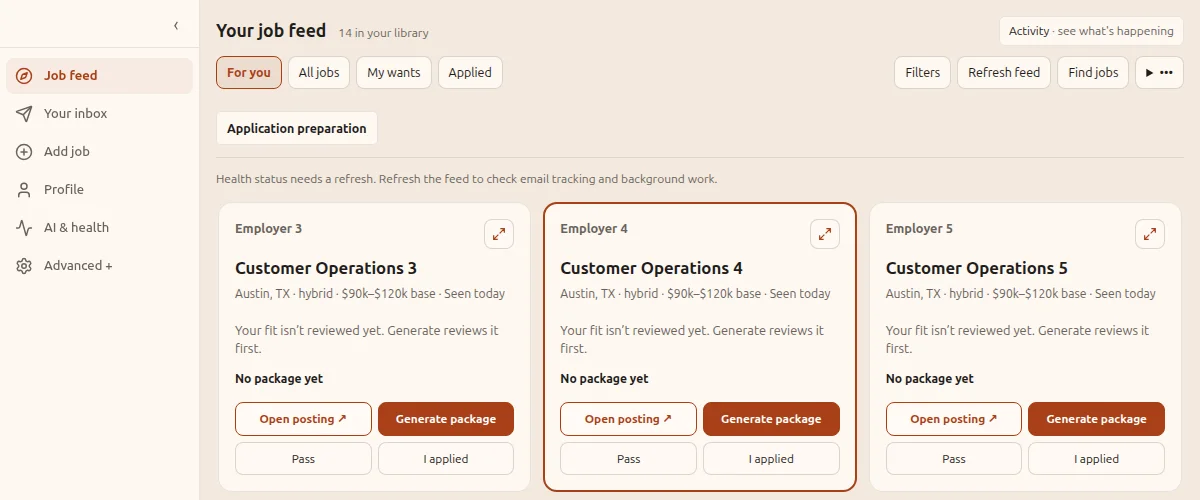
Test data. Every employer here is made up.
The problem
Job sites are full of stale reposts. The real listings live on each company's own careers page, and nobody has time to check 500 of those every morning.
What I built
A job radar that goes straight to the source every day, keeps the list fresh, and sorts it by what I actually want.
The twist
It interviews me. When a job asks for something it can't back up yet, it asks if I have a story about it.
Straight to the source, every day.
Instead of trusting job aggregators, Jobsbot reads company career pages directly. It knows how to read the six most common hiring platforms, plus eight big-company career sites that each do their own thing.
My search, my rules.
Everything about what shows up is a setting I control: which roles count, where, how fresh, and which companies to skip for now. I can even overrule its rating with my own "my call" when I know better.
The AI side is adjustable too. Each of its 8 jobs (rating a posting, drafting, reviewing edits and so on) gets its own model and effort level, and every batch runs under a spending cap.
"My name is Jev."
It reads every posting. It answers multiple choice. That's it. That's Jev.
Jev is a small AI model that doesn't chat. You give it a piece of text and a list of multiple-choice questions, and it answers each one from a fixed menu. That makes it cheap, fast and easy to check.
In Jobsbot, Jev reads each posting (and only the posting, never anything about me) and answers questions like "how many years does this job actually require?" Then plain rules turn those answers into my fit band. Change the rules and nothing needs re-reading.
The more I tell it, the better it gets.
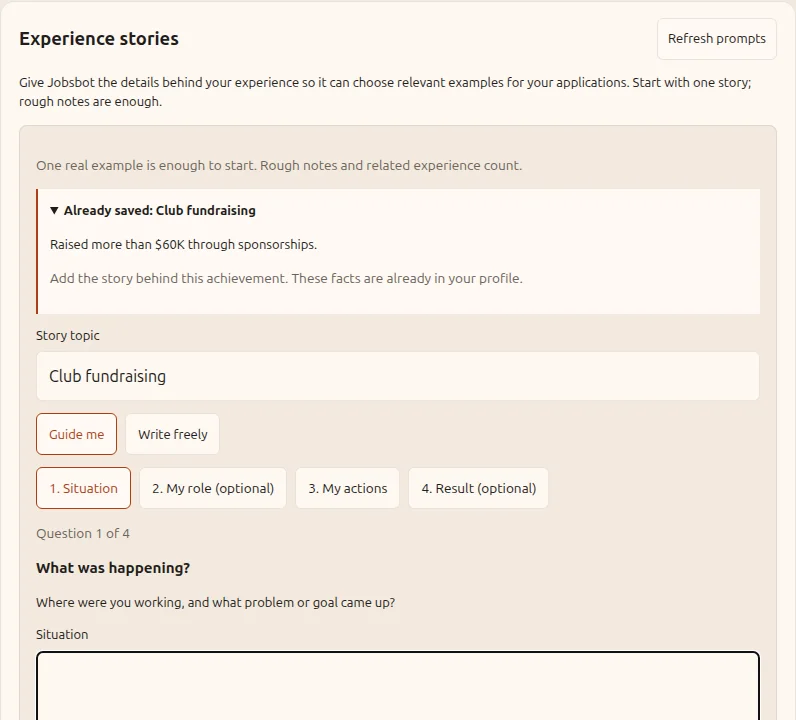
Most résumé tools only know your résumé. Jobsbot notices what each job asks for that my profile can't back up yet, and asks me about it.
- "This job asks for X. Got a story?"Up to 3 prompts per job. Spotting them costs no AI calls.
- A 4-step interviewSituation, my role, what I did, the result. Rough notes are fine.
- Saved in my wordsThe story becomes a fact the writer can use in future applications.
Similar jobs sink in the feed. Interest, interviews and offers do the opposite. Only the last 90 days count, so old moods fade out.
Every "no thanks" teaches it something.
Passing on a job takes one tap and a reason. Those reasons reshape the ranking, so the feed drifts toward what I actually want. Notes on a draft go back to the writer as instructions. Feedback can change the wording, but it can't invent new things about my career.
And it won't fib. Every claim in a draft gets checked against my confirmed facts. On a test of 81 made-up claims, it let zero through (the old word-matching checker let 11 slip). It's a small test I graded myself, so take it as a good sign.
Indexbot →the library everything reads from